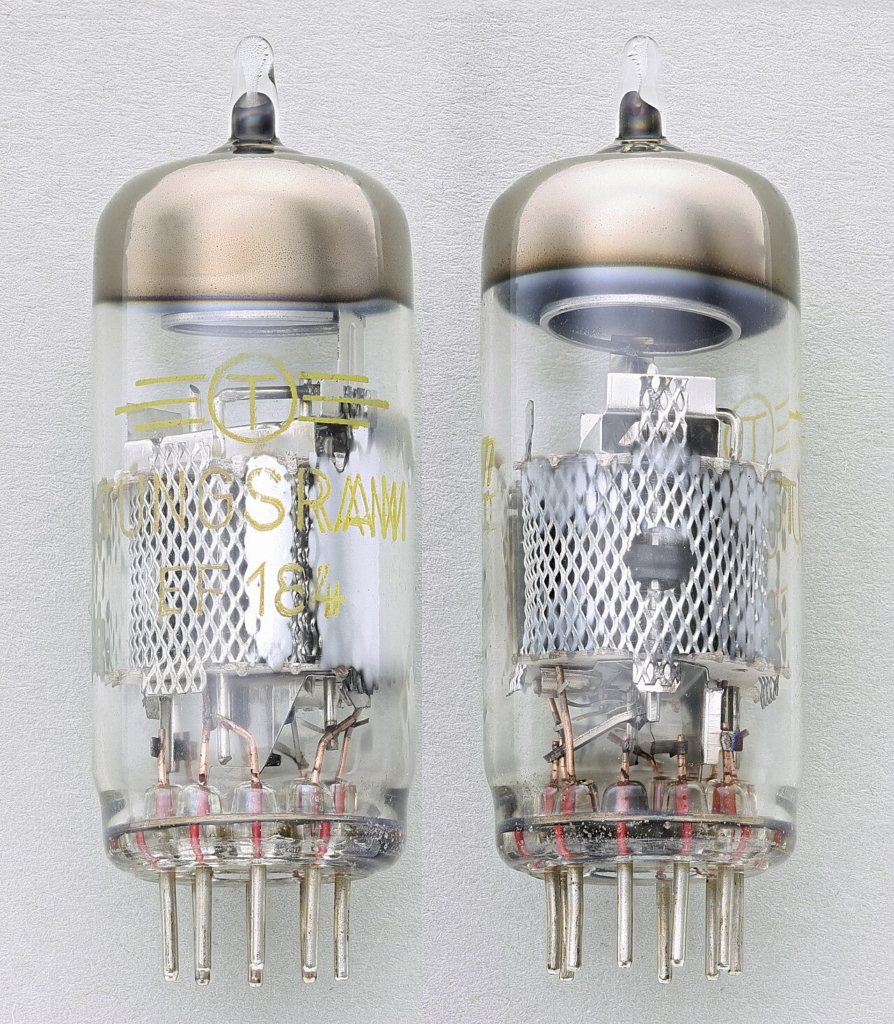
A sharp cut-off frame-grid pentode from 1960 that gave television IF strips their gain — and quietly became a hi-fi sleeper.
Born for television
The 6EJ7 arrived in 1960 as a sharp cut-off amplifier pentode for TV intermediate-frequency strips. Its European twin, the EF184, was a purpose-designed high-gain VHF frame-grid pentode that superseded the EF80, and the same tube could also serve as an RF amplifier for 405-line television or Band II FM. Museums Victoria holds a Mullard 6EJ7 from about 1965, described as a sharp cutoff pentode designed for television receivers, made by Philips in Hendon, South Australia.
At a glance
| Type | Sharp cut-off frame-grid pentode (B9A) |
| Introduced | 1960 |
| Heater | 6.3 V / 0.3 A |
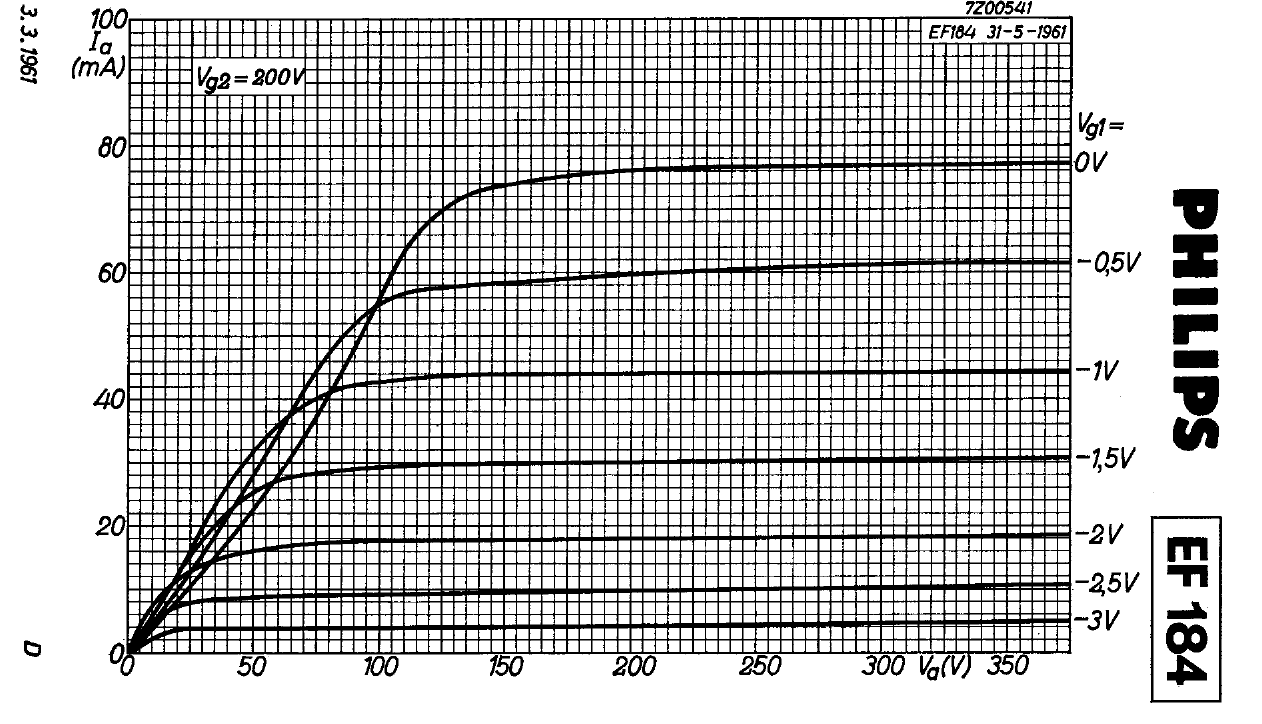
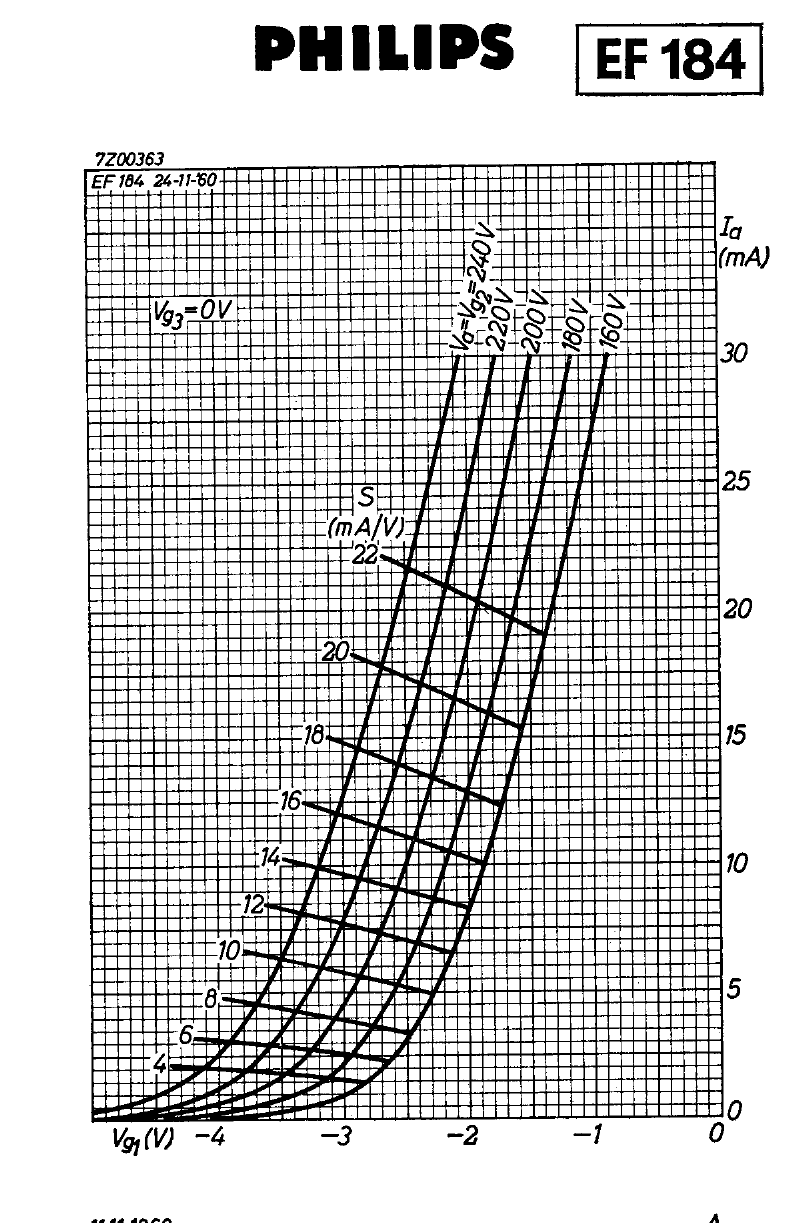
| Typical operating point | Va 170 V, Vg2 170 V, Vg1 −2 V, Ia 10 mA, gm 15.6 mA/V |
| Maximum ratings | Va 250 V, Pa 2.5 W, Ik 25 mA |
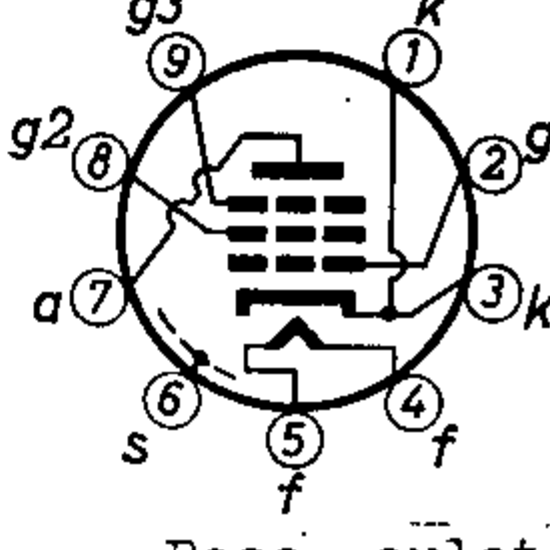
| Pinout | 1=k, 2=g1, 3=k, 4=h, 5=h, 6=internal shield, 7=a, 8=g2, 9=g3 |
| Equivalents | EF184, 6F30, CV5810; Soviet 6J51P |
Pin map & plate curves
The paperwork that matters at the bench — the base diagram and the factory curves, straight from the Philips EF184 datasheet.
In audio
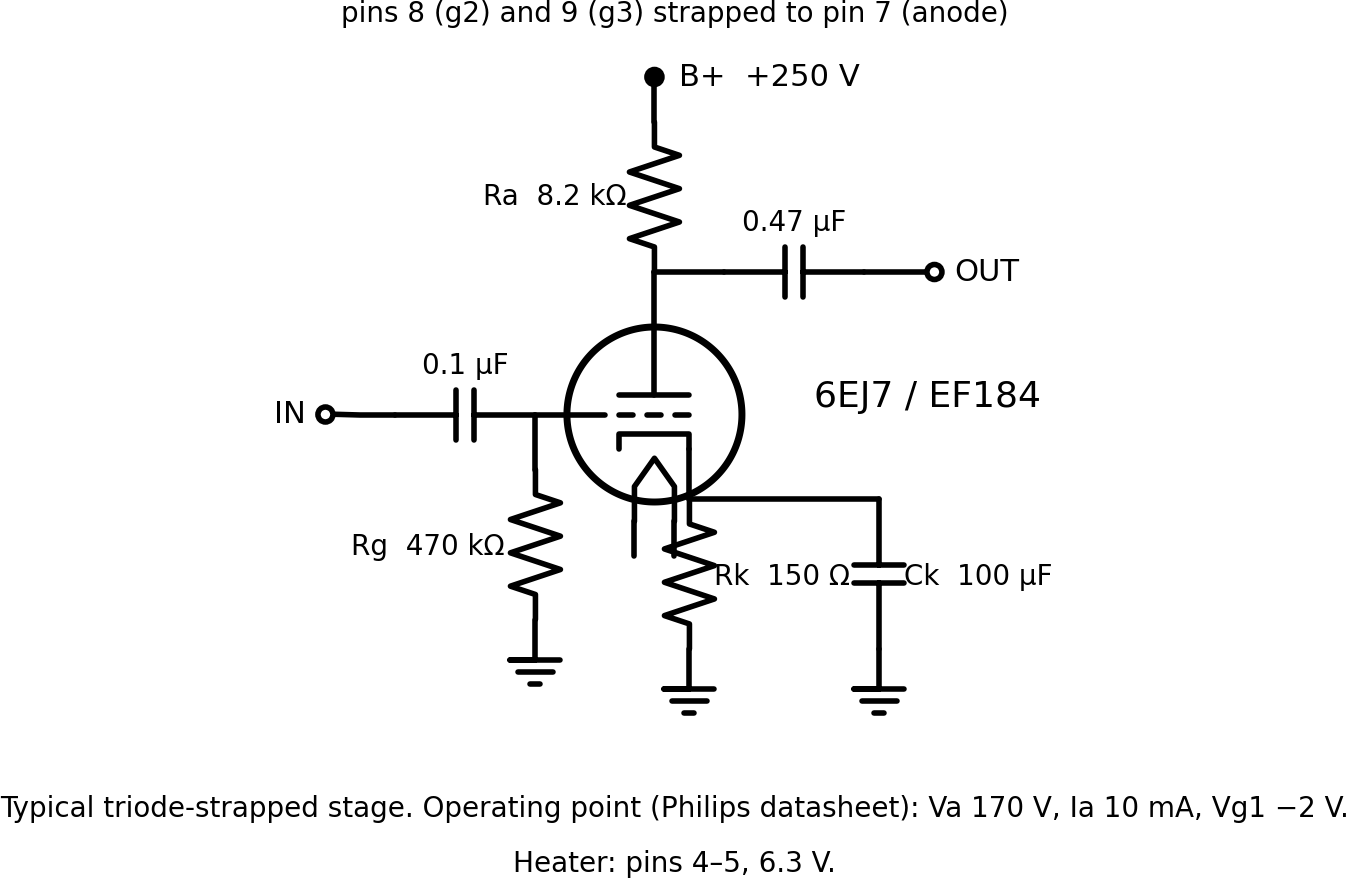
A pentode with this much transconductance was bound to attract audio builders. In the audioXpress May 2026 Glass Audio Special, Zoran Dukic’s moving-magnet RIAA phono preamplifier uses triode-connected EF184s — linear at 6 mA, CCS-loaded, two gain stages around a passive RIAA network, for 50 dB of gain. DIY builders have followed the same path: N. Filipovic’s SMPS-powered MM RIAA preamp (April 2026) uses the EF184 in triode mode as its first stage. Triode-strapped, the type shows a mu of about 55–60 with gm around 15 mA/V — small-signal behaviour closer to a high-gain triode than to a typical pentode.
Eric’s experience
— Eric’s own notes will go here.
Sources: r-type.org tube museum (6EJ7 and EF184 pages); Museums Victoria collection item 1149332; audioXpress, May 2026; nfilipovic.com; Philips EF184 datasheet (Electronic Tube Handbook). Researched November 2026.