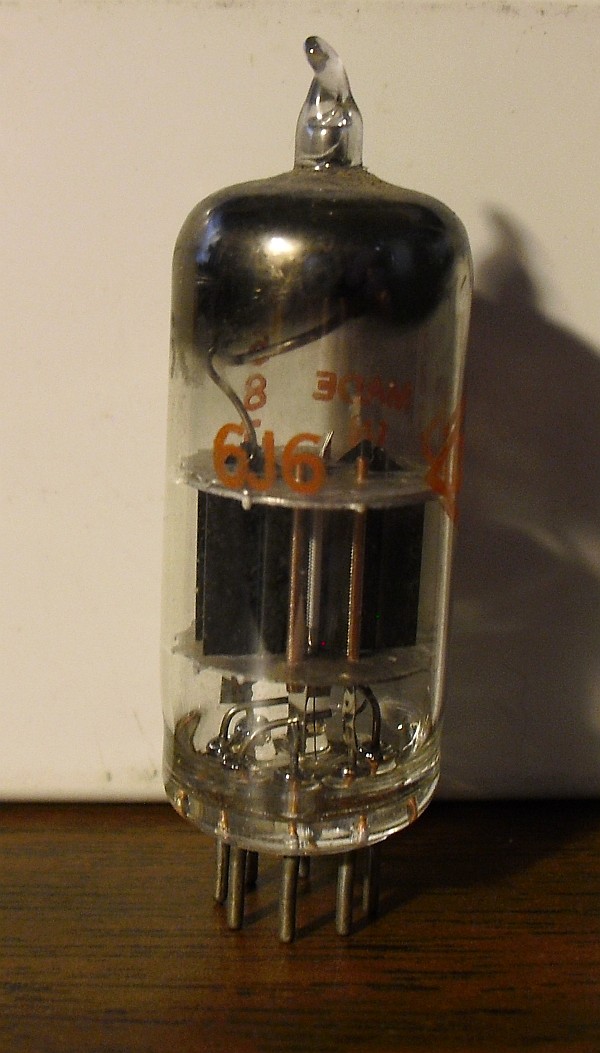
📷 A photo from my own collection will go here.
6J6 / 6J6A / ECC91 — a miniature double (twin) triode for VHF signal amplification. Researched 2026-11-17. Every fact is followed by its source. Datasheet/manufacturer facts are separated from retailer claims and forum opinion.
History and intended use
- Miniature double (twin) triode for VHF signal amplification; American design, the ECC91 a later European copy; one of the earliest B7G types; the two sections share one common flattened cathode, with grids either side and U-channel anodes; envelope 18 mm × 44–45 mm excluding B7G pins. http://www.r-type.org/exhib/aaa0399.htm
- Introduction year: r-type says 1944; CryptoMuseum and forum sources say RCA registered it in September 1942 (re-registered 1949) — discrepancy flagged. https://cryptomuseum.com/valves/6j6.htm
- Tung-Sol datasheet: “particularly adaptable for service as mixers at frequencies as high as 600 megacycles.” https://w140.com/tekwiki/images/6/6e/Tung-Sol_6J6_data_sheet.pdf
Datasheet block (Tung-Sol, 1 Oct 1956 + r-type)
- Heater 6.3 V / 0.45 A; max heater-cathode +100 V. Tung-Sol sheet above.
- Pinout (B7G): 1=a(2), 2=a(1), 3=h, 4=h, 5=g(1), 6=g(2), 7=k (common cathode). http://www.r-type.org/exhib/aaa0399.htm
- Typical point: Va 100 V, Vg −0.85 V, Ia 8.5 mA, ra 7,100 Ω, gm 5.3 mA/V, mu 38; cathode bias resistor 50 Ω (both sections). Tung-Sol sheet above; r-type table agrees.
- Max ratings: plate voltage 300 V max, plate dissipation 1.5 W per section, plate current 15 mA max. Tung-Sol sheet above (note: the sheet’s OCR renders “300” garbled in places — read as 300 V).
- 6J6A differs only in controlled heater warm-up time (~11–12 s; OCR shows both figures) and increased heater-cathode insulation; otherwise identical. Tung-Sol sheet above; Radiomuseum (citing GE Essential Characteristics 1973): “Similar to 6J6 with controlled heater warm-up time and increased heater-to-cathode insulation, suited for use even in television sets employing 450 mA series-connected heaters”; first source 23 May 1956. https://www.radiomuseum.org/tubes/tube_6j6a.html
Equivalents
- ECC91, CV858, CV4031, 6CC31; Soviet 6N15P (6Н15П). http://www.r-type.org/exhib/aaa0399.htm ; https://btb-elektronik.de/en/products/tubes/preamplifier-tubes-double-triodes/other-double-triodes/
- World Tube Company substitution list adds 6H15N, 6030, 7244, A4434, TS52. http://www.worldtubecompany.com/mm5/merchant.mvc?Screen=TSL-6J
- 6101 / 6J6-WA is the premium/military version: RCA’s Industrial & Communications Types manual (1960) recommends “the 6101/6J6-WA” for military uses. https://archive.org/download/RCA_Industrial_and_Communications_Types_1960/RCA%20Industrial%20and%20Communications%20Types%201960_text.pdf
- Variants (CryptoMuseum, secondary): 6J6L long-life (50,000 h), 5964 special computer coating; the type is “less suitable for AF applications.” https://cryptomuseum.com/valves/6j6.htm
Audio use and reputation (mostly forum — labelled)
- The honest headline is a negative-to-mixed reputation. MIT’s 6.S917 Tube Electronics lab calls the 6J6 “a real junker of a tube… not meant for audio,” chosen because it is very cheap and high-volume; the common cathode limits topologies. https://tubes.mit.edu/6S917/2024/labs/lab02
- Forum: a builder’s 6J6 long-tailed-pair phase-inverter amp measured <0.035% THD at 5 W (Audio Asylum). https://www.audioasylum.com/audio/tubes/messages/28/286881.html
- Forum: the shared cathode is an advantage for cathode-coupled/phase-inverter use; sections in parallel double gm and halve rp (AM Forum). http://amfone.net/Amforum/index.php?topic=36411.0;wap2
- Forum/DIY: a 6J6-based variant of the Starving Student Millett Hybrid headphone amp — “6J6 is not brilliantly linear, although a headphone amp has quite small signals”; builds at ~48–50 V reported sounding nice. https://www.diyaudio.com/community/threads/6j6-based-ssmh.197845/
Buying notes (indicative)
- World Tube Company: 6J6/ECC91 NOS $3.95; 6J6A/ECC91 NOS $2.95. https://www.worldtubecompany.com/mm5/merchant.mvc?Session_ID=5885c93cd0c30d1bef6069045e9a1277&Screen=CTGY&Store_Code=WTC&Category_Code=1J-N
- Soviet 6N15P ~$1.95–$3.99 each in lots; Mullard ECC91 singles up to ~£25. https://picclick.com/6N15P-6%D015%D0%9F-soviet-Dual-Triode-Vintage-Vacuum-Tube-127900575170.html ; https://picclick.co.uk/ECC91-6J6-Mullard-rebranded-Philips-NOS-NIB-Platinum-253076246038.html
Photos
- https://www.paleotechnologist.net/wp-content/uploads/2012/07/6j6_sm.jpg — page: Paleotechnologist, “Rediscovering Vacuum Tubes, Part 1” (paleotechnologist.net), captioned “A 6J6 dual-triode vacuum tube.”
- https://i.ibb.co/RYFMcjR/6j6.jpg — page https://ibb.co/CmcXQPR (ImgBB). Note: that page’s own text link reads https://i.ibb.co/PFLbgDq/6j6.jpg — the two URLs disagree; the footnote URL is the one cited here.
- https://i.ibb.co/TKQ5F4J/6J6-PP.png — “6J6-PP” push-pull build, page https://ibb.co/B4hRSyv (ImgBB; same link-mismatch caveat).


Could not verify
- Any established use as a reverb driver — no source found; likewise no canonical commercial audio design.
- Introduction year (1942 vs 1944, above); 6J6A warm-up time (11 vs 12 s in OCR).
- A fully legible second typical operating point (the Tung-Sol sheet’s 150/250 V data is only partially OCR-readable).
Eric’s Experience
Eric will add his own bench experience here.