📷 A photo from my own collection will go here.
1J6G / 1J6 / 1J6GT / 1J6GX — a Class B double (twin) triode for battery radios. Researched 2026-11-17. Every fact is followed by its source. Datasheet/manufacturer facts are separated from retailer claims and forum opinion.
What it is — with the filament correction (multiple manufacturer sources)
- Class B double (twin) triode, octal (IO) base, directly heated filament 2.0 V / 0.24 A. r-type Radio Valve Data row: “1J6-G, 1J6-GT, Class B double triode, 2.0* 0.24, anode 135 V, grid 0 V, ra 10.0 kΩ, RL 10 kΩ, Po 2.1 W, IO base, 1937.” https://www.r-type.org/data/rvd-095.htm
- Raytheon Radio Tube Data (June 1945): “1J6G TWIN TR FIL 2.0 0.24, 7AB-OS8, CLASS B, two sect., plate 135 V, grid 0, output 2.1 W, load 10,000 Ω”; substitution chart lists 1J6G ↔ 19. https://www.worldradiohistory.com/Archive-Catalogs/Suppliers/PQR/Raytheon-Radio-tube-data-and-substitution-chart-manual-1945-46-pages.pdf
- Sylvania Characteristics Chart (1945): “1J6G, ST-12 bulb, Duo-triode, basing 7-AB, Filament 2.0 V 0.24 A, Power Amp Class B”; a later Sylvania chart: “Characteristics same as Type 19.” https://www.worldradiohistory.com/Archive-Catalogs/Suppliers/STU/Sylvania-Radio-Tubes-Characteristics-1945-20-pages.pdf
- RCA Receiving Tube Manual: “HIGH-MU TWIN POWER TRIODE. Glass octal types used in output stage of battery-operated receivers. Filament volts (DC) 2.0, amperes 0.24. Typical Class B: plate volts 135 max, peak plate mA per plate 50 max, grid volts 0, effective plate-to-plate load 10,000 Ω, output 2.1 W. Type 1J6-G is a DISCONTINUED type listed for reference only; 1J6-GT used principally for renewal purposes.” https://www.scribd.com/document/490176194/RCA-Recieving-Tubes-1950-OCR-Page-0078
- Museums Victoria (Philips Miniwatt 1J6G, Sydney, 1940–1945): “High mu twin triode. Designed for use as a push-pull zero-bias Class B amplifier… more than 2 watts from a 135 volt supply. Octal version of the earlier type 19. 2.0 volt directly heated cathode, filament 2 V at 240 mA.” Physical: octal base, 8 pins, shouldered glass bulb, 103 mm × 39 mm. https://collections.museumsvictoria.com.au/items/415173
- The 1.4 V figure belongs to the different 1G6G/1G6GT (~0.35 W output class) — do not confuse the two types.
Pinout (flagged — see could-not-verify)
- Basing 7AB (manufacturer charts above). Partial evidence: War Dept TM 11-435 (1944, amplifier BC-641-C) puts the signal “on the two grids (4–5) of the 1J6G” with output from pins (3–6), plate-to-plate load 10,000 Ω, filament supply 2–3 V, plate 100–135 V, ~2 W undistorted. https://www.uslweb.com/library/files/tm-11-435-1944-01.pdf — and a NostalgiaAir forum post states 2 V should appear between pins 2 and 7 (i.e. filament pins 2 & 7). http://www.NostalgiaAir.org/Forums/t54861.htm — Working pinout: filament 2 & 7, grids 4 & 5, plates 3 & 6 — derived from a service manual and a forum post, not read off a manufacturer basing diagram.
Variants and equivalents
- 19 = predecessor (1933); Radiomuseum’s type 19 page: “Similar tubes, other base: 1J6G” and “Successor tubes: 1J6G.” https://www.radiomuseum.org/tubes/tube_19.html — Raytheon lists 1J6G ↔ 19 as directly interchangeable (base differs).
- 1J6GT = smaller GT-bulb renewal version (RCA, above).
- 1J6GX: existence confirmed by the NostalgiaAir cross-reference (“1J6GX, High Mu Twin Power Triode”) http://www.nostalgiaair.org/Tubes/ and the 1980 Tube Substitution Handbook (1J6G 7AB → 1J6GT, GX; 1J6GX 7AB → 1J6G, GT) https://www.worldradiohistory.com/BOOKSHELF-ARH/Technology/Technology-Vacuum-Tube/Tube-Substitution-Handbook-1980-115-pages.pdf — what the X suffix denotes was not verified.
Period and modern use
- Period battery sets (Radiomuseum model pages): Philco 37-38 series (1937) 6-tube battery chassis ending in a 1J6G, supplies 135/90/2 V (2 V storage battery, or 3 V dry battery with ballast). https://www.radiomuseum.org/r/philco_37_38j37_3.html ; https://www.radiomuseum.org/r/philco_37_38b37_3.html
- Zenith 7J259 (1938) ran its 1J6 output tube’s 2 V filament in series with two dial lamps (shunted by 27 Ω resistors) from a 6.3 V supply. http://www.antiqueradio.com/Aug04_Arnold_Zenith.html
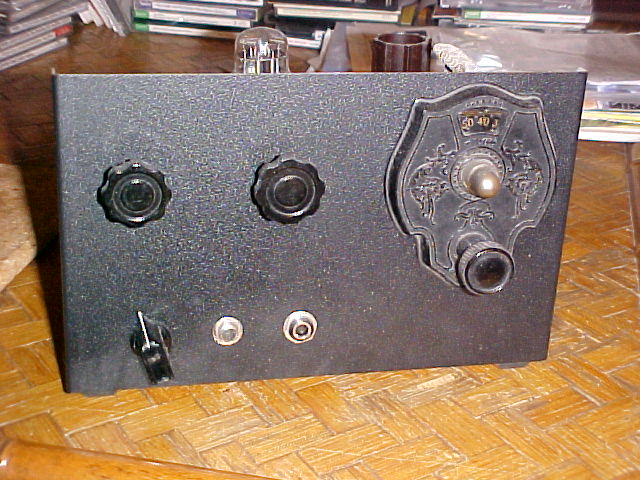
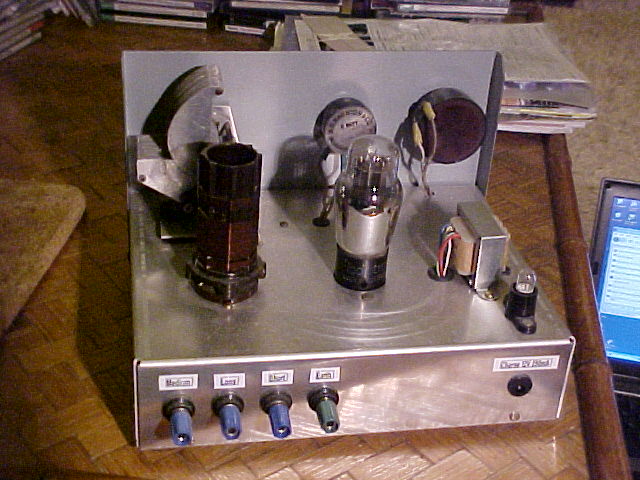
- Modern DIY (verified project): a one-valve regenerative receiver using the 1J6 as detector + headphone audio amp — 2 V/240 mA, zero bias, Class B idle 10 mA rising to 30 mA at full output (author states 2.2 W at 135 V vs RCA’s 2.1 W — discrepancy noted); warns single-ended use is mediocre even paralleled, and stresses the 1G6 (1.4 V) is a different tube. https://www.cool386.com/1J6/1j6.html
- 1947 QST “Last Ditcher” one-tube emergency transmitter used a 1J6G (two flashlight cells for the filament, B battery 22.5–180 V, ~2 W input at 135 V/17 mA, 80/40 m). https://onetuberadio.com/2022/08/25/1947-last-ditcher-one-tube-transmitter/
- Collector rationale (inference from the sources above, not a sourced quote): it is the output tube of 1930s 2 V farm/battery radios, the octal successor to the 1933 type 19, and still cheap NOS.
Buying notes (indicative)
- Surplus Sales of Nebraska: Sylvania 1J6G $10.00, in stock (product metadata fetched live). https://WWW.surplussales.com/items/163295/1j6g-sylvania/
- Brent Jessee list: $9.00. http://users.rcn.com/brentjes/bjtubes.htm
- Turntable Store, tested Sylvania 1J6G: $4.99. https://www.theturntablestore.com/collections/vacuum-tubes?page=5
Photos
- https://www.theturntablestore.com/cdn/shop/files/IMG_3520.jpg?v=1746550863&width=3024 — “Sylvania 1J6G Vacuum Tube * Tested 105/108.” Page: https://www.theturntablestore.com/collections/vacuum-tubes?page=5
- https://www.theturntablestore.com/cdn/shop/files/IMG_3521.jpg?v=1746550863&width=3024 — second view, same listing/page.
- https://www.theturntablestore.com/cdn/shop/files/IMG_3518.jpg?v=1746550791&width=3024 — second Sylvania 1J6G listing (“Tested 108/108”), same page.
- In-situ backup: https://www.cool386.com/1J6/front19.JPG and https://www.cool386.com/1J6/rear19.JPG — receiver front/rear showing the valve in use; page https://www.cool386.com/1J6/1j6.html


Could not verify
- Full pinout from a manufacturer basing diagram (Frank’s datasheet index lists AWV/Sylvania/Tung-Sol 1J6G PDFs if a final check is wanted: https://frank.pocnet.net/sheets15.html).
- Meaning of the 1J6GX suffix.
- Introduction year: r-type’s equivalents index says 1936, its Radio Valve Data says 1937. http://www.r-type.org/equivs/web01.htm
- Output power 2.1 W (RCA/Raytheon) vs 2.2 W (cool386 author); exact zero-signal plate current (Raytheon OCR garbled; cool386 says 10 mA total idle).
Eric’s Experience
Eric will add his own bench experience here.